

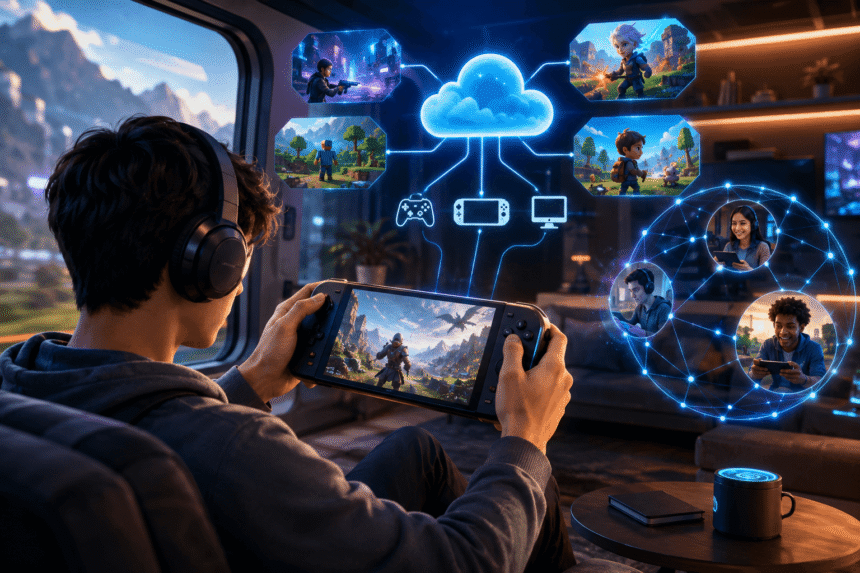
Tportstick gaming trends from ThePortableGamer refers to discussions about developments in portable gaming, including handheld consoles, cloud gaming, mobile gaming technology, and cross-platform experiences. The phrase appears in ThePortableGamer’s gaming coverage, although Tportstick itself has not been clearly established as a specific gaming console or hardware product. The most useful way to understand these trends is to examine the technologies changing how people access, play, and enjoy games away from traditional desktop setups.
| Category | Details |
|---|---|
| Main topic | Tportstick gaming trends from ThePortableGamer |
| Associated website | ThePortableGamer |
| Primary focus | Portable gaming technology, devices, and player experiences |
| Major trends | Hybrid consoles, handheld PCs, cloud gaming, and cross-device gaming |
| Relevant devices | Nintendo Switch 2, Steam Deck, Windows gaming handhelds, and PlayStation Portal |
| Tportstick product status | No clearly verified mainstream hardware specifications |
| Intended audience | Mobile gamers, handheld enthusiasts, and gaming technology followers |
What Are Tportstick Gaming Trends from ThePortableGamer?
The phrase describes gaming developments associated with portable play and related technology coverage. Articles using this terminology discuss how gaming is becoming more flexible through smaller devices, streaming services, improved hardware, and connected gaming platforms.
ThePortableGamer’s gaming archive includes an article titled Tportstick Gaming Trends From ThePortableGamer: Portable Play Insights And What To Watch In 2026. This establishes a connection between the search phrase and the website’s portable-gaming content.
However, an important distinction exists between coverage of a technology trend and confirmation of a particular product.
Some third-party articles describe Tportstick as a compact gaming stick or controller. Those descriptions do not establish a consistent manufacturer, operating system, official product specification, or recognised hardware release.
Tportstick is therefore better understood as an ambiguous term associated with gaming coverage rather than a verified alternative to established consoles.
The underlying portable-gaming developments, however, are real and worth exploring.
Major Tportstick Gaming Trends from ThePortableGamer in 2026
1. Hybrid Gaming Consoles Offer Greater Flexibility
One of the clearest developments in portable gaming is the continued evolution of hybrid consoles.
A hybrid console allows players to use the same system in different environments. Games can be enjoyed on a television at home or through a built-in screen when travelling.
The Nintendo Switch 2 demonstrates this approach through three supported configurations: TV mode, tabletop mode, and handheld mode.
Its hardware includes a 1080p display and support for higher-resolution output on compatible televisions. The system can also play compatible physical and digital games originally released for Nintendo Switch.
Not every older title works perfectly, so players should check Nintendo’s compatibility information before purchasing.
The broader trend is straightforward: gamers increasingly have access to devices designed for different playing environments without requiring separate gaming systems for every location.
2. Handheld Gaming PCs Combine Portability with PC Libraries
Handheld gaming PCs represent another significant development.
Unlike traditional portable consoles, these devices are built around PC gaming environments. They can provide access to supported PC games, configurable graphics settings, external accessories, and different input methods.
Valve’s Steam Deck is an established example.
According to Valve’s official Steam Deck OLED specifications, the OLED model includes:
- A 7.4-inch HDR OLED display with a refresh rate of up to 90Hz.
- A 50Wh battery rated for approximately 3–12 hours of gameplay.
- Built-in thumbsticks, trackpads, and motion controls.
- Expandable storage through microSD cards.
These features illustrate the balance handheld manufacturers must strike between performance, battery life, screen quality, and comfort.
Windows-based gaming handhelds offer another route for players who want access to compatible PC storefronts and gaming services.
However, portability does not guarantee desktop-level performance. Demanding games may require reduced graphics settings, lower frame-rate targets, or shorter sessions between charges.
The best handheld experience depends on how effectively a device balances power consumption, game compatibility, and practical usability.
3. Cloud Gaming Reduces Dependence on Local Hardware
Cloud gaming is especially relevant to discussions of tportstick gaming trends from ThePortableGamer because it changes where game processing happens.
Rather than running an entire game locally, a compatible device receives a video stream from remote servers. Player inputs are transmitted back to the service, which processes the game and returns the updated image.
Microsoft’s Xbox Cloud Gaming supports gaming on various compatible devices, including smartphones, tablets, PCs, and selected televisions.
Sony provides another example through PlayStation Portal.
Originally focused on Remote Play from a PS5 console, PlayStation Portal also supports cloud streaming of selected PS5 games through PlayStation Plus Premium. This allows eligible games to run without relying on an active PS5 console at home.
The distinction matters because cloud gaming and Remote Play are not identical. Cloud gaming relies on remote service infrastructure, while conventional Remote Play streams games from a user’s own console.
There are also limitations. Streaming quality depends on internet stability, network latency, service availability, and subscription eligibility.
For travellers using unreliable Wi-Fi or limited mobile data, locally installed games may remain the more dependable option.
4. Cross-Device Progress Makes Gaming More Convenient
Portable gaming is no longer defined only by the device someone carries. It also involves whether their games and progress can move between supported platforms.
Cross-device progression allows players to continue certain games without restarting their progress on each system.
Microsoft’s Xbox Play Anywhere programme provides a concrete example. Eligible digital games can be played across supported Xbox consoles, Windows PCs, and Windows gaming handhelds, with shared saves, achievements, and eligible add-ons.
This is particularly useful for players who alternate between a home console and a portable PC.
However, several commonly confused features should be distinguished:
- Cross-play allows players on different supported platforms to play together.
- Cross-save or cross-progression allows supported progress to carry between devices.
- Cross-buy provides access to supported versions of a purchased game across multiple platforms.
A game can offer one feature without offering the others.
Players should verify the individual game’s capabilities instead of assuming that every title supports all three.
5. Gaming Accessories Become More Important
Portable gaming accessories can improve comfort and convenience, but compatibility matters more than simply adding equipment.
External controllers, carrying cases, protective accessories, charging equipment, and storage devices serve different needs.
For example, players using phones for cloud gaming may prefer a compatible physical controller over touchscreen inputs. Handheld PC owners may benefit from a case that protects the built-in display and control sticks during travel.
Storage requirements also differ between devices.
Nintendo Switch 2 uses microSD Express cards for expanded game storage, while Steam Deck supports compatible microSD storage. These standards are not interchangeable simply because the cards have similar physical dimensions.
This illustrates an important purchasing principle: accessories should be chosen for a particular device rather than for portable gaming as a whole.
The most useful accessories solve a practical problem, such as uncomfortable controls, limited storage, or difficulty transporting equipment safely.
How Portable Gaming Is Changing Player Habits
These developments affect more than hardware specifications.
Portable systems allow players to adjust gaming sessions around their environment. A person might play a locally installed game during a journey, continue a supported PC title at home, or use cloud streaming when a compatible internet connection is available.
Different gaming formats also suit different circumstances.
Puzzle games, turn-based strategy titles, and many independent games can work well during short sessions. Competitive multiplayer games may require a more stable connection, precise controls, and uninterrupted playing time.
Handheld PCs can support extensive gaming libraries, but their physical weight, heat output, and battery requirements may make them less convenient for some journeys.
Cloud streaming can reduce the need for powerful local processors, but it introduces dependence on networks and service access.
As a result, portable gaming is not moving toward one universally superior device. It is developing into several approaches that serve different needs.
How to Evaluate Tportstick Gaming Trends and Related Claims
Because the Tportstick name is used inconsistently online, readers should distinguish documented technology from unsupported product descriptions.
A reliable gaming hardware claim should ideally be supported by manufacturer documentation, identifiable model numbers, compatibility information, and independent testing.
For example, Nintendo publishes official details about Switch 2 play modes and compatibility. Valve provides Steam Deck hardware specifications, while Microsoft and Sony explain their respective gaming services.
These sources provide a stronger basis for understanding portable gaming than promotional descriptions without identifiable technical documentation.
Before buying a device associated with a trending gaming term, consider its actual function.
Does it run games locally, stream them from another system, or simply provide controller inputs? Does it support existing game purchases? Can it operate offline? What equipment or subscriptions are required?
The answers determine whether the device is useful and whether its advertised capabilities are realistic.
What Comes Next for Portable Gaming?
The direction of portable gaming suggests continued attention to hardware efficiency, display technology, streaming functionality, and cross-device access.
Manufacturers face several practical challenges.
More powerful processors can improve performance but may increase heat and energy consumption. Higher-resolution displays can improve image quality while placing additional demands on the system.
Meanwhile, cloud services must maintain reliable performance across different networks and supported devices.
Game publishers also face growing expectations around saved progress, platform compatibility, and convenient access to purchased content.
Future improvements will depend on how successfully manufacturers and service providers address these limitations.
The most meaningful developments are likely to be those that make portable gaming easier to use without sacrificing reliability, control quality, or access to games.
Frequently Asked Questions
1. Is Tportstick an actual gaming console?
Tportstick has not been clearly verified as an established mainstream gaming console with consistent official specifications. Although some websites describe it as a device, the available information is insufficient to confirm a specific product. The term is more reliably associated with portable-gaming articles and trends.
2. What gaming devices are relevant to Tportstick gaming trends from ThePortableGamer?
Relevant examples include Nintendo Switch 2, Steam Deck, Windows gaming handhelds, PlayStation Portal, and smartphones capable of running or streaming supported games. These products demonstrate the different approaches currently used in portable gaming.
3. Can portable gamers play high-quality games without expensive hardware?
Yes, in some circumstances. Cloud gaming services can stream supported games to compatible devices without requiring those devices to perform all the processing locally. However, players still need suitable hardware, a reliable internet connection, and any required subscriptions or game licences.
4. What should gamers prioritise when choosing a portable gaming device?
The most important factors are game compatibility, battery life, controls, portability, storage, and whether the device supports offline play. Players interested in PC libraries may prefer a handheld PC, while those wanting a hybrid console experience may find Nintendo Switch 2 more suitable. Cloud-focused players should also consider network quality and subscription requirements.
Conclusion
Tportstick gaming trends from ThePortableGamer provides a useful starting point for understanding the changes taking place across portable gaming, even though the Tportstick name itself lacks a clearly verified hardware identity.
The most significant developments involve hybrid consoles, handheld gaming PCs, cloud streaming, cross-device progression, and practical accessories. Together, these technologies give players more choices about where and how they enjoy games.
For gamers following these trends in 2026, the key is to focus on verified capabilities, genuine compatibility, and the playing experience rather than unsubstantiated product claims.
Read also hosted event etsgamevent by etruesports: Simple Guide