

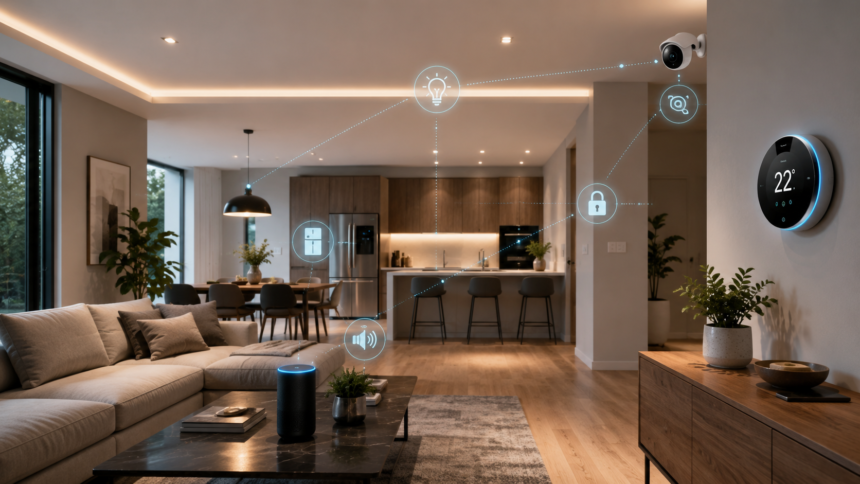
Smart homes Techoelite refers to Techoelite.com’s coverage of connected-home technology rather than a clearly documented proprietary smart-home system. Techoelite describes itself as a website focused on gaming and technology, while its article titled Smart Homes Techoelite: The Future of Living Is Here discusses familiar smart-home concepts such as automated lighting, thermostats, security cameras, voice control and connected devices.
That distinction matters. Someone searching the phrase might reasonably assume “Techoelite” is a home-automation manufacturer, platform or technical standard. The pages reviewed do not present the smart-home topic that way. The useful question, therefore, is not which “Techoelite system” to buy, but how to apply the connected-home ideas associated with the term using real standards, compatible products and sensible security practices.
What does “Smart Homes Techoelite” actually mean?
Techoelite’s smart-home article, credited to Kathleen Burrell, defines a smart home as a residence where connected devices can be controlled through smartphones, voice interfaces or automation. It highlights lighting, climate control, cameras, hubs and energy monitoring while also acknowledging compatibility, cybersecurity and technology-dependence concerns.
Techoelite’s About page, meanwhile, describes the site as a destination for games and technology content. It does not position the website there as a manufacturer of home-automation hardware or as the organization behind a technical smart-home protocol.
For readers, the practical interpretation is straightforward:
“Smart homes Techoelite” is best understood as a smart-home information topic associated with the Techoelite website, not as the name of a technical standard comparable with Matter, Thread, Zigbee or Z-Wave.
That clarification prevents an important purchasing mistake: choosing devices because they appear to fit a loosely defined “Techoelite” ecosystem instead of checking the protocols and platforms the products actually support.
The technology that really determines whether a smart home works
A reliable smart home is less about filling a house with Wi-Fi gadgets and more about choosing technologies that can communicate predictably.
Several different layers are involved.
| Technology | What it does | Where it fits |
|---|---|---|
| Matter | Provides a common application protocol for compatible smart-home devices | Cross-brand interoperability and multi-platform control |
| Thread | Provides a low-power, IP-based mesh network | Sensors, locks and other connected devices, including Matter-over-Thread products |
| Zigbee | Combines low-power mesh networking with an established device ecosystem | Lighting, sensors, switches and existing hub-based installations |
| Z-Wave | Uses a low-power, sub-GHz mesh network designed around home automation | Locks, sensors, lighting, security and professionally integrated systems |
These technologies overlap, but they are not interchangeable.
Matter is the compatibility layer to watch
Matter is developed through the Connectivity Standards Alliance. The Alliance describes it as an IP-based protocol designed to increase interoperability between products from different brands and smart-home ecosystems. Matter can operate over networking technologies including Wi-Fi, Ethernet and Thread.
This distinction is important: Matter is not simply another wireless radio. It provides a common way for supported devices and controllers to understand one another.
That can reduce one of the problems highlighted in Techoelite’s smart-home article—the possibility of buying devices that cannot communicate with the rest of the home. Matter does not eliminate every compatibility problem, however. A standard may define a capability before every manufacturer or platform has implemented it, and particular products can expose different feature sets.
Thread handles low-power networking
Thread is an open, IP-based mesh networking protocol designed for connected devices. According to the Thread Group, devices can form a self-healing network, while Thread Border Routers connect that network to technologies such as Wi-Fi and Ethernet. Battery-powered end devices such as sensors and locks can operate differently from powered devices that help route traffic through the mesh.
Matter and Thread therefore solve different problems. Matter provides the application language; Thread can provide the network carrying those communications.
A product labeled Matter over Thread uses both.
Zigbee remains relevant
Matter has not made older smart-home standards disappear.
Zigbee remains an established low-power mesh technology with a large installed ecosystem. The Connectivity Standards Alliance describes Zigbee as a full-stack IoT solution with self-healing mesh networking, low-power operation and certified interoperability.
For a household that already owns a compatible Zigbee hub and numerous bulbs, sensors or switches, replacing everything merely because Matter is newer may offer little practical benefit. A better goal is integration: retain reliable equipment where possible and choose future additions based on whether the controlling platform can bring the old and new devices together.
Z-Wave is another established home-automation option
Z-Wave is particularly established in residential control, security, locks, sensors and energy-management applications. The Z-Wave Alliance describes it as a low-power smart-home technology using a certified interoperable device ecosystem and mesh networking.
The important lesson is that a sophisticated connected home may contain more than one protocol. What matters is whether the controller, bridge or automation platform can manage them without making everyday operation unnecessarily complicated.
What smart-home technology can genuinely improve
The strongest smart-home upgrades solve a specific problem. Automation for its own sake often produces more apps, accounts and maintenance rather than a better home.
Climate control can produce measurable savings
Energy efficiency is one area where there is stronger evidence than generic claims about a “smarter lifestyle.”
ENERGY STAR says certified smart thermostats must demonstrate energy savings using real-world data from homes. Its published guidance estimates average savings at approximately 8% of heating and cooling costs, or about $50 annually, while stressing that actual results depend on climate, occupancy, equipment and individual comfort preferences.
That qualification is important. Buying an internet-connected thermostat does not automatically guarantee savings. The value comes from reducing unnecessary HVAC operation while maintaining appropriate comfort settings.
Before purchasing one, check HVAC compatibility carefully. Homes with specialized or variable-capacity equipment may benefit from manufacturer-recommended controls rather than whichever popular smart thermostat happens to have the most features.
Lighting automation is usually about convenience first
Smart bulbs and switches can automate routines such as:
- turning exterior lights on at sunset;
- switching unused rooms off when no occupancy is detected;
- creating a low-light nighttime pathway;
- coordinating multiple lights with one scene;
- controlling difficult-to-reach fixtures.
The benefit is not simply the ability to operate a bulb from a phone. A wall switch is already faster than opening an app in many situations. The advantage appears when sensors, schedules and other conditions eliminate repetitive manual actions.
Sensors can be more useful than flashy appliances
Small sensors often provide some of the highest practical value in a smart home.
Leak sensors can alert occupants to unexpected water. Contact sensors can indicate whether doors or windows are open. Motion and occupancy sensors can trigger lighting or climate routines. Temperature and humidity sensors can help automation react to changing conditions.
These are examples of a broader principle: a smart home becomes useful when devices share information and produce an appropriate response, not merely when individual appliances have apps.
Security should be part of the buying decision
Connected homes introduce another consideration that ordinary light switches and mechanical locks largely avoid: software lifecycle management.
NIST’s consumer IoT cybersecurity work identifies cybersecurity capabilities as an important part of connected products. Its 2026 revision of guidance for IoT manufacturers emphasizes security throughout the product lifecycle and the information manufacturers provide to customers.
For a homeowner, that translates into several practical questions before buying a connected device:
- Does the manufacturer explain how the product receives security updates?
- Is there a stated support or end-of-life policy?
- What happens if the manufacturer’s cloud service becomes unavailable?
- Can important functions still be operated manually or locally?
- What information does the device collect?
- Can unnecessary data collection or remote access be disabled?
- Does the account protecting cameras, locks or alarms support strong authentication?
- Is the device from a manufacturer likely to maintain its software for the period you expect to own it?
These considerations become more important as a device gains physical or privacy-sensitive capabilities. A discontinued decorative smart bulb is annoying. An unsupported door lock, camera, garage controller or alarm component deserves considerably more attention.
Local control versus cloud control
One of the most useful questions to ask about any smart-home purchase is simple:
What still works when the internet is down?
Cloud services make remote access and cross-device integrations convenient, but a home should not become unusable because an outside server cannot be reached.
Matter specifically emphasizes local IP-based connectivity as part of its architecture, helping compatible devices communicate within the home rather than requiring every basic interaction to travel through a remote cloud service.
That does not mean every Matter product is completely cloud-independent. Manufacturers can still offer cloud-based features, accounts, remote access and proprietary services. The distinction is that basic Matter functionality is designed around interoperable IP communication rather than a single vendor’s private cloud protocol.
For essential systems, local operation and a physical fallback remain valuable features.
Matter has continued to evolve in 2026
Smart-home guidance becomes outdated quickly, which is why the version of Matter being discussed matters.
The Connectivity Standards Alliance released Matter 1.6 on June 17, 2026. Rather than introducing a large collection of new device categories, the update concentrated on setup, coordination between ecosystems and richer device behavior.
Among the notable additions are:
- NFC-based commissioning, allowing supported products to be configured through NFC, including scenarios in which installation makes later access difficult;
- Joint Fabric, designed to make coordinated control by multiple authorized ecosystems more practical;
- Thermostat Suggestions, which lets ecosystems make standardized recommendations that a thermostat can evaluate against user preferences and current conditions;
- improved communication of device capabilities and operating limits;
- interoperable security-sensor event-history information;
- additional status information for smoke and carbon-monoxide alarms.
The Alliance also makes an important qualification: specification releases and consumer product availability do not occur simultaneously. Manufacturers and smart-home platforms adopt new Matter capabilities according to their own development schedules.
So a box marked “Matter” should not be assumed to support every capability added to the latest specification. Check the actual product and ecosystem documentation.
How to build a smart home without creating a mess
A practical smart-home plan starts with the problem rather than the gadget.
1. Decide what you want to automate
Write down several outcomes that would materially improve the home. Examples might include lowering unnecessary HVAC use, receiving water-leak alerts, automatically lighting a hallway at night or checking whether a door was left open.
That prevents impulse purchases that never become part of a useful automation.
2. Choose the main control platform
Decide where everyday control should live. The platform might be an existing smart-home ecosystem, a dedicated hub or another automation controller.
Then check each prospective device against that platform before purchasing it.
Matter can make cross-brand compatibility easier, but certification and feature support still need to be checked at product level.
3. Treat networking as infrastructure
A smart home cannot compensate for unreliable underlying connectivity.
Before adding dozens of devices, identify dead zones and decide which technologies will serve which device types. High-bandwidth products and low-power sensors have different networking requirements. Thread, Zigbee and Z-Wave use mesh approaches specifically suited to connected-device scenarios, although their architectures differ.
4. Start with one useful category
Lighting, a compatible thermostat or a small set of sensors is easier to troubleshoot than attempting whole-home automation immediately.
Use the first installation to learn how routines behave, how quickly devices respond and what happens during internet or power interruptions.
5. Add automations gradually
Start with rules whose outcome is predictable:
motion detected after dark → hallway light on
is easier to diagnose than a complex routine involving occupancy, geolocation, weather, temperature, security status and several cloud services.
Complexity should be earned by a clear benefit.
6. Keep manual controls
Physical switches, manual lock operation and conventional thermostat controls are not obsolete simply because automation is available.
The best connected home does not force every resident or guest to understand its technology.
Is a “Techoelite smart home” something you can buy?
Based on the Techoelite pages reviewed, “smart homes Techoelite” should not be treated as the name of a documented proprietary product ecosystem. Techoelite presents the subject editorially, describing the general features and benefits associated with smart-home technology.
If you encounter another site using phrases such as “Techoelite smart home system,” “Techoelite standards” or “Techoelite home automation,” look for primary product documentation before assuming those phrases identify a manufacturer, certification or technical protocol.
For an actual purchase, the labels that matter are the product manufacturer, supported platform, wireless technology, relevant certification, software-support policy and the particular functions implemented by the device.
What to take from the Smart Homes Techoelite idea
The core idea behind Techoelite’s smart-home coverage is sound: connected lighting, climate control, security devices and automation can make a house more responsive to its occupants.
The technology has also become more interoperable. Matter now provides a common application standard across an expanding range of products, while Thread, Zigbee and Z-Wave continue to provide useful networking options for different types of installations.
But the smartest purchasing strategy is not to automate everything. Start with a problem worth solving, choose products with documented compatibility and long-term support, favor resilient local operation where it matters, and expand only when the next device adds a useful capability.
That approach produces something more valuable than a house filled with connected gadgets: a home in which the technology quietly does its job.
Pages
- Techoelite — “Smart Homes Techoelite: The Future of Living Is Here.” The opened page does not display a publication date. https://techoelite.com/smart-homes-techoelite/
- Techoelite — “About.” The opened page does not display a publication/update date. https://techoelite.com/about/
- Connectivity Standards Alliance — “Build With Matter | Smart Home Device Solution.” Current reference page; no publication date displayed. https://csa-iot.org/all-solutions/matter/
- Connectivity Standards Alliance — “Matter 1.6 Enables More Intuitive Setup, Multi-Ecosystem Experiences, and Context-Driven Control.” June 17, 2026. https://csa-iot.org/newsroom/matter-1-6-enables-more-intuitive-setup-multi-ecosystem-experiences-and-context-driven-control/
- Thread Group — “Smart Home Connectivity with Thread.” Current reference page; no publication date displayed. https://threadgroup.org/BUILT-FOR-IOT/Smart-Home
- Connectivity Standards Alliance — “Zigbee Standard: Full-Stack Wireless IoT Solution.” Current reference page; no publication date displayed. https://csa-iot.org/all-solutions/zigbee/
- Z-Wave Alliance — “Smart Home.” Current reference page; no publication date displayed. https://z-wavealliance.org/market_use_case/smart-home/
- ENERGY STAR — “ENERGY STAR Smart Thermostats FAQs for EEPS.” Current reference page; no publication/update date displayed on the opened page. https://www.energystar.gov/products/heating_cooling/smart_thermostats/smart_thermostat_faq
- National Institute of Standards and Technology — “Profile of the IoT Core Baseline for Consumer IoT Products,” NISTIR 8425. Published September 20, 2022; page updated November 29, 2022. https://www.nist.gov/publications/profile-iot-core-baseline-consumer-iot-products
- National Institute of Standards and Technology — “Foundational Cybersecurity Activities for IoT Product Manufacturers,” NIST IR 8259 Rev. 1. Final version published April 20, 2026. https://csrc.nist.gov/pubs/ir/8259/r1/final


