

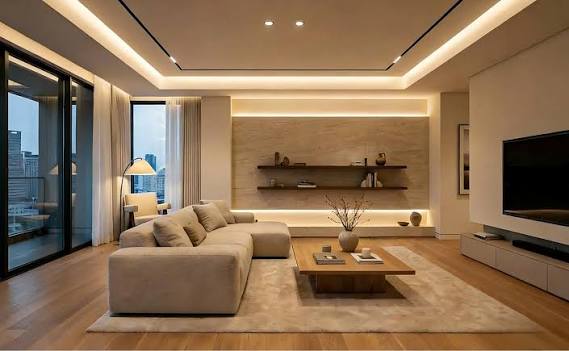
A living room does not always need an even grid of downlights. The ceiling can remain visually restrained while light is directed towards the surfaces and activities that need it. Start with the sofa, reading positions and television, then decide where overhead light will be useful.
This approach is particularly helpful in an open-plan room, where ceiling lights remain visible from several seating areas. A layout that looks balanced on a plan may place a bright source directly in the view of somebody relaxing on the sofa.
Begin with the walls you see from your seat
Look around the room from the main seating positions. You are likely to see walls, curtains, shelves and furniture more than the centre of the floor. Consider how these surfaces will be lit after dark.
A suitable wall light or directed source can make a part of the room useful without requiring every ceiling fitting to remain on. A reading chair may need a local lamp, while artwork may call for its own carefully positioned light.
Use overhead light where it contributes to those needs or to movement through the room. Do not add a fitting simply to complete a symmetrical pattern. An intentional gap can be sensible if another source already does the work.
Draw the ceiling and furniture together. Include any planned changes, such as moving the sofa to face another wall. Decisions based on a temporary furniture arrangement can become inconvenient as soon as the room is finished.
Select Recessed Downlights for the view as well as the finish
When browsing Recessed Downlights at LightHub Direct, compare how the light source sits within the fitting. The range includes styles such as baffle and adjustable designs, which offer different approaches to the visible source and light direction.
A recessed light source or baffle can help limit direct views of the bright element at some angles. The result still depends on the product and its position. Assess the relevant sightlines instead of assuming that an anti-glare description guarantees comfort everywhere.
An adjustable fitting may help direct light towards a feature, but it needs a suitable beam and aiming position. Recessed downlights intended for general light may produce an unhelpful result when asked to illuminate a particular picture or shelf.
Consider the bezel finish after the optical and installation decisions. White can blend with a pale ceiling, while another finish may echo room details. If the goal is a restrained ceiling, adding contrasting circles across it may work against that intention.
Trimless recessed downlights involve their own ceiling-finishing requirements. They should be coordinated with the plastering and installation sequence. Check access and maintenance arrangements rather than choosing them solely from a photograph of the finished room.
Review the television wall separately
Switching on all the lights can reveal reflections that were invisible during daylight. Consider the television screen, glass-fronted pictures and polished furniture from the seats where they will be viewed.
Recessed downlights should be positioned with those reflections in mind. Reducing output may help in some situations, but moving the source or choosing another distribution can address the cause more directly.
Think about what will remain on while the television is in use. A separate lighting group can provide a practical background setting while other ceiling lights are off. Agree that grouping before the wiring and control positions are finalised.
Avoid treating the entire room as a television setting if it is also used for conversation or reading. The lighting needs to offer useful alternatives. Local sources can support different activities without requiring the same brightness everywhere.
Check the room after the furniture arrives
Before final installation, have the electrician confirm ceiling suitability, clearances and the compatibility of any dimming equipment. The physical requirements of recessed downlights remain necessary even when the visual design is deliberately simple.
Then review the completed room after dark. Sit in the main seats, try a book in the reading chair and look towards the entrance. Notice whether a bright source attracts attention or whether a useful surface remains difficult to see.
Where products allow adjustment, ask for aiming and controls to be commissioned for the actual room. Record those settings with the model details. If the sofa moves later, the record gives you a starting point for reviewing the recessed downlights again.
Keep the useful sources and reconsider those that serve no clear purpose. A comfortable living room lighting scheme comes from the relationship between the light, the furnishings and the people using them. The number of ceiling fittings is only one part of that arrangement.