

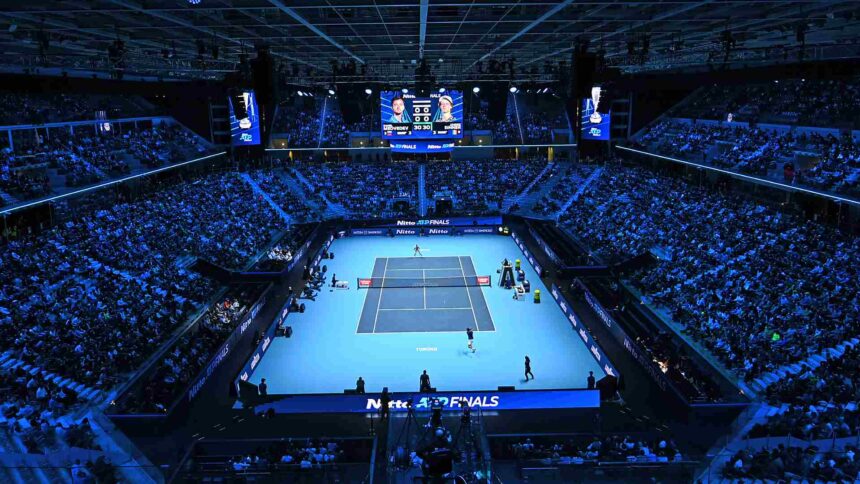
The 2026 Nitto ATP Finals begin in Turin on Sunday 15 November, bringing together the eight players who have earned the most points across the men’s season. The event is the last major singles tournament on the ATP calendar, but it does not follow a standard knockout format.
Every player is guaranteed three round-robin matches before the semi-finals. That gives a poor opening result less finality than at a Grand Slam, but it also means a difficult group can shape the entire week before the first ball is struck.
Carlos Alcaraz, Alexander Zverev, Ben Shelton, Daniil Medvedev, Flavio Cobolli, Arthur Fils, Frances Tiafoe and Rafael Jodar have qualified for the singles event at the Inalpi Arena. Their route to Turin has been very different, which should make the draw on Thursday 12 November a significant moment.
Tennis interest is no longer limited to live broadcasts and newspaper columns. Supporters follow form, fitness and tournament schedules across social platforms, statistics services and new betting sites, but the ATP Finals rewards a closer look at the possible match-ups rather than a simple view of the world rankings.
The format can punish one bad draw
The eight qualifiers will be split into two groups of four. Each player faces the other three members of their group, with the top two progressing to the semi-finals.
That system makes every set important. A player can lose their first match and still qualify, yet another defeat could leave them needing help from results elsewhere in the group. If two players finish level on wins, the tournament uses further criteria to separate them.
It is a format that creates more tactical pressure than a normal knockout event. Players cannot afford to write off a difficult match, even if they are already close to elimination. A tight set against a direct rival may carry value later in the week.
The group stage also allows rivalries to develop quickly. A match that looks like a round-robin fixture on Sunday could become decisive by Friday, depending on the results around it.
Alcaraz arrives with a chance to win Turin for the first time
Carlos Alcaraz is chasing his first ATP Finals title. He has already established himself as one of the most dangerous players in men’s tennis, but Turin remains a difficult event to win because indoor hard courts can reward a different type of game.
The conditions favour players who serve well, take the ball early and control shorter rallies. Alcaraz has the power and movement to handle those demands, though the event will test his ability to stay patient against opponents who can consistently put pressure on his return games.
A first ATP Finals trophy would add another major achievement to his season. It would also confirm that he can win in a setting that offers no easy early rounds and no opportunity to build slowly against lower-ranked opponents.
The opening group will reveal a lot. Alcaraz could find himself alongside another aggressive player such as Shelton or Tiafoe, creating matches built around attacking tennis. A group with Medvedev or Zverev would pose a different challenge, requiring longer rallies and a more controlled approach.
Zverev knows how to win the event
Alexander Zverev has already won the ATP Finals twice, in 2018 and 2021. That experience gives him an advantage when the pressure rises in Turin.
The German has a strong record in indoor conditions. His serve can dominate short points, while his backhand gives him a reliable option when opponents try to force the ball into one corner of the court.
Zverev’s previous success also means he knows how to manage the unusual rhythm of the event. Players compete several times in a short period, then have to recover physically and mentally before the semi-finals.
His aim will be to control the first two group matches and avoid arriving at the final round-robin fixture needing a particular result. That position is never comfortable, especially in a tournament where every opponent belongs among the season’s strongest eight players.
Shelton and Tiafoe bring an attacking threat
Ben Shelton and Frances Tiafoe are both capable of making an indoor hard-court tournament unpredictable. Their styles are different, but each can take momentum away from an opponent quickly.
Shelton’s serve and left-handed game can create awkward patterns, particularly against players who prefer to settle into long baseline exchanges. He has become more composed across extended matches, and Turin offers a chance to test that progress against the best players of the year.
Tiafoe has the variety and athleticism to disrupt more methodical opponents. His willingness to change pace, move forward and improvise can make him difficult to read when he is playing with confidence.
Neither player can rely on one explosive performance. The ATP Finals format demands consistency across several matches, and that has often separated the strongest contenders from players who arrive with an eye-catching run of form.
Still, both have the ability to change the group stage. A win against a higher-ranked rival could alter the path to the semi-finals for everyone involved.
Medvedev’s return game could be decisive
Daniil Medvedev has the experience and patience needed for the ATP Finals. He is comfortable absorbing pressure, extending rallies and forcing opponents to hit one extra shot.
That makes him a particularly difficult opponent for players who rely on quick points. A strong server can dominate for most of a set, then find Medvedev returning one key game well enough to change the score.
Indoor conditions may suit his flat groundstrokes, especially if the court plays at a pace that allows him to take control from behind the baseline. His ability to adjust during a match could be important in a group containing contrasting styles.
Medvedev does not need to overpower every opponent. His game can become more effective as a match develops, particularly when a rival begins to force shots or becomes frustrated by long exchanges.
Cobolli, Fils and Jodar can make the field less predictable
Flavio Cobolli, Arthur Fils and Rafael Jodar enter Turin with less ATP Finals experience than some of their rivals, but that does not make them easy opponents.
Cobolli will have the support of an Italian crowd behind him. Playing at home can bring extra expectation, though it can also provide energy during close matches. A strong start would quickly turn the Inalpi Arena into a major advantage.
Fils has the power to trouble any player in the field. His challenge will be maintaining his level across three demanding group matches. At the ATP Finals, a brief drop in concentration can be enough to lose a set and place a player under pressure for the rest of the week.
Jodar’s qualification adds a fresh element to the tournament. First-time participants can arrive without the emotional baggage that comes with previous disappointments, and that freedom can make them dangerous. His opponents will still expect a high level, but there is less history to draw on when preparing for him in this setting.
The schedule leaves little recovery time
Round-robin matches run between Sunday 15 November and Friday 20 November. The semi-finals take place on Saturday, with the singles final scheduled for Sunday 22 November.
That compact schedule makes recovery important. A player who spends three hours on court in a difficult opening match may still need to play again within a short period. Small physical issues can become more serious when there is little time to reset.
The event is also a mental test. Players know they have more than one chance after a defeat, but that can create its own pressure. They must return to the court and perform while knowing that every game could influence their route out of the group.
Turin will provide the final opportunity of the year for the leading players to win a major title. The draw will set the early story, but the round-robin format ensures that the tournament can change direction very quickly.