

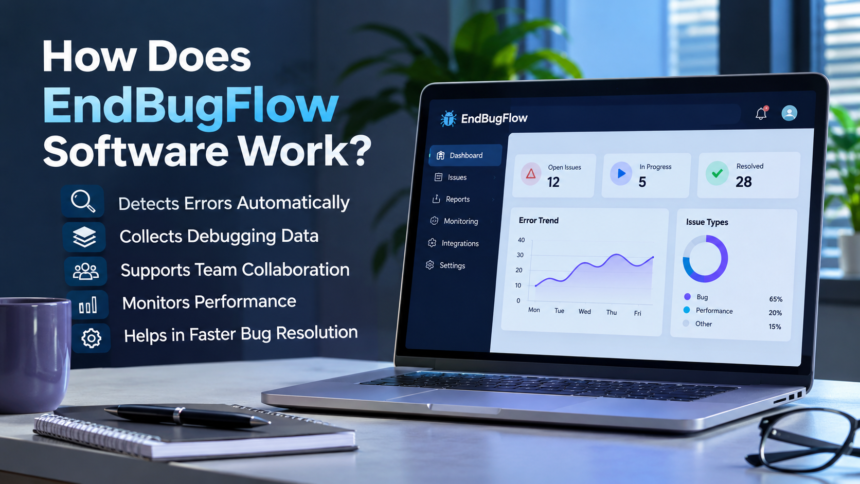
Finding a software bug is one thing. Understanding why it happened and fixing it without creating another problem is often much harder. Developers sometimes spend hours checking error logs, reproducing failures, and exchanging messages with teammates just to identify a single issue.
This is where debugging and error-tracking tools become useful. EndBugFlow software is described as a solution designed to make software problems easier to identify, investigate, and manage.
But how does EndBugFlow software work, and what makes its approach different from traditional debugging?
According to its published descriptions, EndBugFlow focuses on collecting error information, supporting team collaboration, and monitoring application performance. However, its complete technical implementation has not been independently verified, so it is important to distinguish its advertised features from confirmed capabilities.
This guide explains the reported workflow, major features, potential benefits, limitations, and important considerations for developers.
What Is EndBugFlow Software?
EndBugFlow software is presented as a debugging and workflow management solution intended to help development teams understand software errors and organize the process of fixing them.
In ordinary software development, a bug may appear because of incorrect code, unexpected user input, network failures, or problems communicating with external services. Identifying the source of these errors can require information from several different systems.
EndBugFlow’s described approach is to bring relevant debugging information together so developers can investigate an issue without repeatedly switching between tools.
Its website also publishes educational content about software development, debugging, and workflow optimization. Although the website describes several software features, publicly available documentation does not clearly establish every detail of a standalone EndBugFlow application.
How Does EndBugFlow Software Work?
The simplest way to understand how EndBugFlow software works is to follow the journey of a software error from its discovery to its resolution.
The reported workflow involves detecting an application problem, collecting technical information, organizing the findings, helping developers investigate the cause, and monitoring the application after changes are made.
For example, suppose a customer tries to submit an online form, but the page suddenly stops responding.
Without detailed monitoring, a developer might need to contact the customer, ask what happened, examine server logs, and attempt to reproduce the error.
EndBugFlow’s proposed approach is to preserve useful information about the failure so the developer has more context from the beginning.
The overall process can be summarized as:
Error Detection → Data Collection → Issue Analysis → Team Investigation → Bug Fixing → Testing → Monitoring
This represents the workflow described in EndBugFlow’s material. It should not be interpreted as proof that every stage operates automatically in a verified product.
Automated Error Detection
One of the main features associated with EndBugFlow is automated error detection.
Software applications can experience several types of problems, including unexpected crashes, failed API requests, incorrect responses, and performance slowdowns.
An automated error-monitoring system can observe selected application events and record technical information when something goes wrong.
EndBugFlow’s website describes this type of monitoring as an important part of its debugging approach.
The practical advantage is straightforward. Instead of waiting for a user to report a problem, developers may receive information closer to the time the error occurs.
However, the available material does not clearly explain which software agent, SDK, or collection method EndBugFlow uses to detect errors.
Collecting Error Information
Detecting an error is helpful, but developers also need to understand the circumstances surrounding it.
EndBugFlow’s published descriptions suggest that its error-capture process can collect information such as console logs, stack traces, network activity, user interactions, and device details.
A stack trace shows the sequence of function calls associated with an error. Console logs may reveal warnings or failed operations, while network information can help identify unsuccessful requests.
Browser versions, operating systems, and device information can also be important because certain bugs occur only in particular environments.
For example, a checkout page might work correctly on a desktop computer but fail on a specific mobile browser.
Having this information available in one report could make the problem easier to reproduce.
The exact collection methods, data fields, and privacy controls used by EndBugFlow still require verification.
Organizing Bug Reports
A software team may receive dozens or even hundreds of error reports during a busy development cycle.
Not all reports represent different problems. Several users might encounter the same underlying issue, while other errors may have completely different causes.
An effective bug-reporting workflow organizes information so developers can understand what needs attention.
Useful details typically include the error message, affected application, time of occurrence, environment, steps to reproduce the issue, and current investigation status.
EndBugFlow is described as supporting a more organized approach to debugging.
However, specific features such as automatic duplicate detection, customizable ticket statuses, and built-in priority assignment have not been fully established through publicly available technical documentation.
Finding the Root Cause
Identifying an error message does not always explain why a program failed.
For example, a website might display a payment failure because of a network timeout, an incorrect API configuration, or a problem with the payment service itself.
Developers need to investigate the underlying cause rather than simply removing the visible error.
Root-cause analysis involves examining available evidence, reproducing the problem when possible, and identifying the specific condition responsible for the failure.
EndBugFlow’s proposed error-capture workflow could support this process by placing relevant diagnostic information together.
This can reduce unnecessary guesswork, but developers still need to evaluate the evidence carefully.
There is currently insufficient public evidence to confirm that EndBugFlow independently identifies every root cause or automatically generates reliable fixes.
Team Collaboration
Debugging often involves more than one person.
A tester may discover the problem, a developer may investigate the code, and another team member may verify whether the fix works correctly.
When these people use separate communication channels, important details can get lost.
EndBugFlow’s website describes collaborative debugging as one of its core features. It claims that team members can share error reports and examine relevant information without manually collecting screenshots and log files.
It also mentions possible connections with Jira, Slack, and GitHub.
Such integrations could help teams communicate about errors, create development tasks, and connect bug reports with code changes.
These integrations are described in EndBugFlow’s own material, but complete public setup instructions and independently verified demonstrations remain limited.
Performance Monitoring
Not every software problem causes an immediate crash.
Sometimes an application continues running while becoming slower, consuming more memory, or producing an increasing number of failed requests.
These problems can affect the user experience long before an application stops working.
EndBugFlow describes proactive performance monitoring as another part of its approach.
Its published material discusses tracking network requests, response times, and memory usage to identify unusual application behavior.
Consider a website that normally responds to requests quickly. If its response time suddenly increases, that change may indicate a database problem, network delay, or overloaded server.
Monitoring these changes could help a development team investigate before the situation becomes more serious.
Although EndBugFlow describes anomaly detection, its exact monitoring algorithms, supported metrics, and alerting capabilities are not fully documented.
A Practical Example
Imagine a small online store where customers occasionally receive an error after clicking the Place Order button.
The development team has tested the checkout process several times, but everything works normally during testing.
This makes the problem difficult to reproduce.
In the debugging workflow described by EndBugFlow, the first step would be to capture information associated with the failed checkout.
That information could include an error message, the failed network request, browser details, and the sequence of relevant user actions.
The developer would then inspect the report to identify possible causes.
Suppose the available evidence points to a request timeout. The developer could investigate the affected service, apply a fix, and run tests to confirm that the checkout process works correctly.
After deployment, monitoring could help determine whether the same error occurs again.
This example illustrates how a contextual debugging workflow can operate. It is not a documented test or verified demonstration of EndBugFlow itself.
How It Fits Into Development
Software development usually involves several environments, including local development, testing, staging, and production.
Each environment presents different debugging challenges.
During development, programmers need to identify problems while writing and testing code. Access to clear error messages and diagnostic information helps them understand incorrect behavior.
During quality assurance, testers need to report problems accurately so developers can reproduce them.
In production, the focus shifts toward detecting unexpected failures and maintaining application reliability.
EndBugFlow’s described approach is relevant to these different stages because it emphasizes collecting error context and communicating findings.
Whether a particular EndBugFlow release supports all these environments, and how it connects to each one, should be confirmed through official technical documentation.
Benefits of the EndBugFlow Approach
The main attraction of EndBugFlow’s described workflow is the possibility of reducing the effort required to investigate software problems.
Better error visibility can help developers understand what happened without relying entirely on incomplete user reports.
Improved communication may allow testers and developers to work with the same technical information.
More consistent bug reporting can make it easier to document problems and track progress.
Early performance monitoring may also help teams recognize unusual behavior before it affects a larger number of users.
These are reasonable potential benefits of an integrated debugging system. However, they should not be confused with measured results from verified EndBugFlow deployments.
Actual improvements would depend on the product’s implementation, the development environment, and the team’s existing processes.
EndBugFlow vs Traditional Debugging
Traditional debugging tools help developers inspect code, set breakpoints, evaluate variables, and examine application behavior during execution.
These techniques remain important because they allow developers to investigate specific programming problems in detail.
EndBugFlow’s published approach places greater emphasis on capturing errors with context and sharing information across a development team.
The distinction is not necessarily about replacing traditional debugging.
A developer may use error-monitoring information to identify a problem and then rely on a conventional debugger to inspect the relevant code.
In practice, effective software troubleshooting often combines several methods rather than depending on one application.
Is EndBugFlow Easy to Use?
Ease of use depends on factors such as installation, setup, integration requirements, dashboard design, and the technical experience of the user.
EndBugFlow’s website presents its approach as a way to simplify complex debugging tasks.
However, there is not enough independently verified product information to assess its actual learning curve.
A beginner-friendly debugging tool should provide clear installation instructions, understandable error reports, and guidance for connecting an application.
For more experienced developers, access to detailed logs, filtering options, integrations, and configuration controls may be especially important.
Until a complete product demonstration or technical manual is available, claims about EndBugFlow’s usability should be treated cautiously.
Limitations of EndBugFlow Software
Although EndBugFlow’s proposed workflow addresses genuine development challenges, several important details remain unclear.
Its website contains articles describing error capture, collaboration, and proactive monitoring. At the same time, its official information page identifies the organization as an independent publication and information resource.
This creates uncertainty about the relationship between the publishing website and a standalone software product.
Publicly available information also does not provide a consistently verifiable explanation of its software architecture, supported platforms, licensing, release history, API documentation, or pricing.
Another limitation is the lack of independently demonstrated performance results.
Claims about faster debugging and improved productivity should be supported by reproducible testing rather than accepted without evidence.
These gaps do not prove that the described software cannot function. They simply mean prospective users should verify the product before relying on it.
Is EndBugFlow Software Safe?
Security is an important consideration when choosing any application-monitoring or debugging tool.
Error reports sometimes contain information that should not be exposed to unauthorized users.
For example, poorly configured logging systems can accidentally record session identifiers, authentication tokens, personal information, or sensitive request data.
Before using EndBugFlow or a similar product, developers should establish what information the tool collects and how that information is protected.
Important considerations include data encryption, access permissions, privacy controls, secure authentication, and data-retention policies.
Organizations should also determine whether diagnostic information is stored locally or transmitted to external servers.
EndBugFlow’s publicly available material does not provide enough technical evidence to independently confirm its security controls.
For this reason, teams should avoid connecting sensitive production systems until the software publisher, installation package, and relevant security documentation have been verified.
How to Evaluate EndBugFlow
If you are considering EndBugFlow for a software project, the first step is to confirm that you are using an authentic product source.
Look for official installation instructions, a clearly identified publisher, supported operating systems, release notes, and a documented support process.
Next, check whether the software provides the specific features your team needs.
For example, a developer primarily concerned with application crashes may need detailed stack traces and exception reports. A larger team might also require task assignment and collaboration features.
It is worth confirming whether advertised integrations actually work with the tools your team already uses.
If a legitimate, verifiable installation package and suitable documentation become available, start with a non-sensitive test project before considering production use.
This allows you to evaluate the actual functionality without unnecessarily exposing important systems or customer data.
Who Can Benefit From This Workflow?
The debugging workflow associated with EndBugFlow is relevant to several types of software professionals.
Software developers can benefit from clear diagnostic information when investigating application errors.
Quality assurance testers need reliable ways to document problems and communicate reproduction steps.
Project managers may benefit from more organized information about unresolved issues and their impact on development schedules.
DevOps engineers often monitor applications, investigate production incidents, and look for recurring performance problems.
Small development teams can also benefit from an organized approach to debugging, particularly when employees handle several responsibilities.
Whether EndBugFlow itself is suitable for these users depends on the availability and verified functionality of its actual software product.
Final Thoughts
So, how does EndBugFlow software work?
Based on its published descriptions, EndBugFlow follows a debugging approach built around detecting application problems, collecting technical context, supporting team investigation, and monitoring software performance.
The goal is to help developers understand errors more clearly and manage the process of resolving them.
These ideas are consistent with established software debugging and monitoring practices.
However, a distinction remains between the workflow described on EndBugFlow’s website and the technical capabilities of a fully verified software product.
Before installing or adopting EndBugFlow, developers should confirm its documentation, supported features, publisher information, and security practices.
Ultimately, the most useful debugging solution is one that provides trustworthy information, fits naturally into an existing workflow, and helps teams resolve problems without creating unnecessary complexity.
Frequently Asked Questions
1. How does EndBugFlow software work in simple terms?
EndBugFlow is described as a debugging system that captures application errors, collects supporting technical details, helps developers investigate problems, and supports monitoring after fixes. However, its exact technical implementation has not been fully verified through public documentation.
2. What is the main purpose of EndBugFlow software?
The main purpose described on its website is to make software troubleshooting more organized by improving error visibility, technical investigation, and communication between development team members.
3. Can EndBugFlow automatically detect software bugs?
EndBugFlow’s website claims automated error-capture capabilities. However, publicly available information does not clearly establish its exact detection technology, supported applications, or installation requirements.
4. Does EndBugFlow automatically fix bugs?
There is no sufficient public evidence confirming that EndBugFlow can independently repair software defects. Developers should expect to investigate errors, review code changes, test solutions, and verify that problems have been resolved.
5. Does EndBugFlow support Jira, Slack, and GitHub?
EndBugFlow’s published material mentions integrations with Jira, Slack, and GitHub. These connections should be treated as advertised capabilities until working integrations and official setup documentation can be independently verified.
6. Is EndBugFlow suitable for beginners?
Its described approach may be understandable to beginners, but the actual learning curve cannot be reliably assessed without a verified product interface, installation process, and user documentation.
7. Is EndBugFlow software free or paid?
A reliable public pricing structure for a standalone EndBugFlow software product could not be confirmed. Users should verify current licensing and costs directly with an authenticated software publisher.
8. Can EndBugFlow improve application performance?
EndBugFlow describes monitoring features that could help identify slow requests and unusual application behavior. Monitoring itself does not automatically improve performance; developers must investigate and resolve the underlying causes.
9. What makes EndBugFlow different from regular debugging tools?
Its published approach emphasizes contextual error capture, collaboration, and proactive monitoring. Traditional debuggers generally focus more directly on inspecting code and application execution. The extent to which EndBugFlow delivers its advertised features remains unverified.
10. Is EndBugFlow software safe to install?
Its security cannot be confirmed from the currently available technical information. Before installation, verify the publisher, download source, digital signatures where available, software permissions, and data-handling practices.