

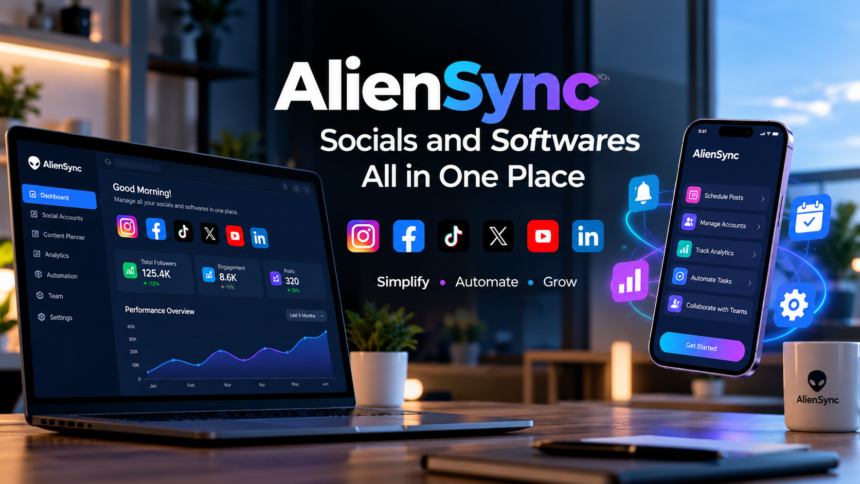
People searching for socials and softwares AlienSync are usually trying to understand whether AlienSync is a social media tool, a software-integration platform, a technology website or a combination of these ideas.
There is an important distinction to make.
AlienSync’s own About page describes the website as an editorial destination covering technology, blockchain, crypto apps, socials and software, and wider technology trends. Its navigation also includes a dedicated Apps – Socials & Software category, which contains articles about applications, digital tools, integrations and online platforms.
At the same time, several AlienSync articles describe a broader concept in which social media accounts, business applications and other digital tools are connected through synchronised workflows. AlienSync itself acknowledges this distinction in one of its July 2026 explainers, describing the name as primarily an editorial and conceptual brand and saying that a publicly verified SDK or API catalogue has not been confirmed.
That makes the most accurate definition fairly simple:
Socials and softwares AlienSync refers to AlienSync’s coverage and conceptual approach to connecting social platforms, applications and business software so that information and actions can move more efficiently between them.
It should not automatically be interpreted as the confirmed name of a mature downloadable SaaS product with every feature mentioned in online articles.
That distinction matters because some pages use product-like descriptions of dashboards, social publishing, automation and integrations, while AlienSync’s more cautious material says these descriptions should be treated as integration concepts rather than verified technical specifications.
For readers, this actually makes the subject more useful. Rather than focusing only on whether one particular application exists, socials and softwares AlienSync can be understood as a way of thinking about connected digital work.
A creator, for example, may use one system for designing content, another for storing files, Instagram and TikTok for distribution, a calendar for planning and an analytics platform for measuring results. A business may add a CRM, customer-support software, an online shop and internal collaboration tools to the same mix.
Without integration, information has to be copied from one place to another. With properly designed integrations, approved data and actions can move between those services automatically.
That is the core idea behind the AlienSync social-and-software concept.
How the Sync Model Works
The word sync is more important here than it might first appear.
Synchronization does not necessarily mean copying everything from one platform into every other platform. A useful integration normally identifies a specific event, determines what information is required and then sends an appropriate action to another authorised service.
Imagine that a company publishes a new product.
The product information might originate inside an e-commerce or product-management system. An automation could notify the marketing team, prepare the approved media assets, add a task to a content calendar and eventually pass selected information to social publishing tools.
This type of process is technically realistic because major social networks already provide APIs and permission systems that allow approved third-party applications to perform certain actions.
TikTok, for example, provides a Content Posting API that can support direct posting or the transfer of content into TikTok for further editing. TikTok requires applications and users to authorise appropriate scopes, and its documentation states that users can approve or deny requested permissions. Direct publishing requires the relevant video.publish permission and additional platform requirements.
LinkedIn similarly uses OAuth 2.0 for user authorisation. Its developer documentation identifies permissions such as w_member_social, which can allow an authorised application to publish social activity on behalf of a member where the application’s access and use case qualify. LinkedIn also maintains a Posts API for creating and managing supported posts.
YouTube provides comparable functionality through the YouTube Data API. Google’s documentation confirms that applications can upload videos through the videos.insert method and that authorised operations use OAuth permissions.
Instagram integrations operate under their own rules. Meta’s published Instagram API material supports capabilities such as media publishing and insights for eligible professional accounts, with specific access permissions required for different actions.
This helps explain why a single connected workflow is attractive but also why connecting social networks is more complicated than simply entering a username and password.
Each platform controls its own APIs.
Each has its own permissions.
Each can restrict what outside software may read, publish, modify or analyse.
A genuine social-software integration therefore depends on authorised APIs, access tokens, appropriate scopes and platform-specific rules rather than unrestricted access to a user’s account.
AlienSync’s conceptual material describes a similar structure: a source such as an app or CRM produces an event, an integration layer applies rules, and selected information is then sent towards another destination. Importantly, the same AlienSync explanation says this architecture is conceptual and that its API references should not be assumed to represent a currently verified public AlienSync developer platform.
This is a much more useful way to understand socials and softwares AlienSync than imagining one mysterious application that automatically controls every digital service.
The idea is essentially about making separate systems cooperate.
Where Social and Software Syncing Can Help
The clearest benefit of connected tools is reducing repetitive work.
Consider content publishing. A social media manager may have the same campaign information stored in a project-management tool, cloud folder, spreadsheet, content calendar and several social networks. Every additional manual transfer creates another opportunity for an outdated image, incorrect caption or forgotten update to appear.
A sensible integration can reduce some of those repeated steps.
For example, a completed content approval could change a campaign status to “ready”, notify the person responsible for publishing and make the correct approved asset available to the publishing workflow.
This is more realistic than attempting to automate everything.
Good synchronization removes predictable repetitive tasks while keeping important decisions in human hands.
Social publishing is only one use.
Customer service is another.
Businesses increasingly receive questions through multiple digital channels. A connected workflow might record selected customer enquiries in a support or CRM system so the team has a more consistent history instead of leaving important conversations isolated inside individual platforms.
Lead handling can follow the same principle. Information legitimately collected through an authorised form can move into a CRM, trigger an internal notification and enter an approved follow-up process.
E-commerce provides another useful example. A campaign management system can coordinate product information with marketing workflows so that staff are not manually rebuilding the same information every time a promotion changes.
For creators, the value may be simpler: organising approved media, planning posts, maintaining calendars and understanding which content belongs to which campaign.
AlienSync’s own material uses examples involving social profiles, CRM-style workflows, e-commerce, analytics and content synchronisation. However, AlienSync also cautions elsewhere that examples on the site should not be treated as named, independently verified case studies of a working commercial platform.
That is an important point for readers.
The concept is legitimate. Modern APIs genuinely make many forms of social and software integration possible, as the developer documentation from TikTok, LinkedIn and YouTube demonstrates.
Whether a particular AlienSync-branded service currently provides a specific integration is a different question and should be verified separately.
A useful rule is to ask what problem needs solving before looking for automation.
If a team spends time repeatedly transferring the same approved information between systems, a controlled integration may help. If a workflow changes constantly or requires judgement on every step, heavy automation may create more problems than it solves.
Integration should simplify a workflow rather than hide a badly designed one.
Security and Account Permissions
The biggest issue with any software that connects multiple social accounts is not convenience. It is access.
Connecting a social account to another application normally means granting that application permission to perform certain activities.
That is why readers should pay close attention to the permission screen rather than clicking “Allow” automatically.
Modern API platforms increasingly use permission scopes to control access. TikTok explains that every developer API requires an appropriate scope and that users can authorise only the permissions they agree to. Users can also revoke authorisation. LinkedIn likewise uses OAuth 2.0 for authorisation and assigns permissions according to the resources and actions an application requires.
The security principle behind this is straightforward: an application should receive only the access it genuinely needs.
NIST defines least privilege as restricting a user or process to the minimum privileges necessary to carry out its assigned task. That principle is particularly valuable when one tool is connected to several business systems.
For example, software that only needs to schedule approved posts should not automatically require unrestricted access to unrelated administrative or billing functions.
Access tokens also deserve careful handling.
TikTok’s developer documentation advises developers to manage tokens carefully and recommends server-side token storage. NIST’s September 2026 guidance similarly highlights the importance of protecting identity and access tokens against theft and misuse because those tokens can provide access to online systems.
The wider OAuth ecosystem has also evolved. The IETF’s current OAuth 2.0 security best-practice document, RFC 9700, recommends modern protections designed to reduce threats such as stolen tokens, unsafe redirects and weaknesses in older authorisation patterns.
For ordinary users and small organisations, the practical lesson is simpler.
Do not connect important social or business accounts to a service merely because its website says that integration is available.
First verify who operates the service, what permissions it requests, how access can be revoked and what happens to stored information.
Multi-factor authentication should also be enabled wherever supported. CISA recommends MFA as an important protection for business accounts, while the UK’s National Cyber Security Centre specifically recommends two-step verification for important services including social media.
Third-party access needs periodic review as well.
CISA’s guidance for protecting organisational social-media accounts recommends having a process to evaluate third-party applications and addressing credentials or tokens promptly when compromise is suspected. The UK’s NCSC likewise advises organisations to consider the security and data-handling implications of third-party applications before allowing them to sync business information.
For an AlienSync-style workflow, a sensible approach would therefore be to connect only necessary accounts, grant the smallest useful set of permissions, enable MFA and periodically remove integrations that are no longer being used.
That is good practice regardless of which automation platform is involved.
What to Verify Before Using AlienSync
This is where readers should separate the AlienSync idea from claims about an AlienSync product.
AlienSync clearly exists as a technology website. Its About page identifies an editorial team and presents the site as a destination for technology, apps, blockchain, software and related subjects. Its Terms and Conditions explicitly describe rules relating to the use of the AlienSync website, while its Privacy Policy discusses website visitors, log files, cookies and advertising-related technologies.
What is less clear is the status of AlienSync as a conventional commercial software platform.
Some AlienSync pages describe extensive platform-style functions, including social hubs, automation, APIs, dashboards, analytics and integrations. Other AlienSync content is much more cautious and explicitly states that no verified public SDKs or documented APIs have been confirmed, while publicly described setup and pricing information should be viewed as conceptual rather than proof of an operational SaaS service.
Even AlienSync’s page discussing supported social networks notes that claimed Instagram, TikTok, X and LinkedIn integrations appear in blog-style descriptions rather than verifiable public product documentation.
Readers should therefore avoid assuming that every feature attributed to AlienSync online is currently available.
Before entering credentials or connecting an important business account, verify several things directly.
Look for a real product dashboard. A functioning service should provide a clear route into the application rather than relying only on articles describing what the platform supposedly does.
Check the integration documentation. Mature software products normally explain what APIs they use, which permissions they request, supported account types and known limitations.
Check the authorisation screen. When a legitimate integration uses services such as LinkedIn, TikTok or YouTube, the platform’s own authorisation process should make requested access visible. Official documentation from these networks demonstrates how permission-based access is expected to work.
Check privacy information. Determine what data is collected, how long it may be retained and how access can be removed.
Test with low-risk access first. A business does not need to connect every social profile, CRM and administrator account on day one. Starting with a limited workflow makes it easier to see what permissions and information are actually required.
This approach also reflects AlienSync’s own more careful advice, which recommends small pilots and limited integration rules rather than immediately synchronising everything.
In other words, the safest interpretation of socials and softwares AlienSync in 2026 is not “a proven all-in-one platform that definitely connects every social network and application”.
It is better understood as an AlienSync technology topic and synchronization framework built around the wider, very real idea of connecting social platforms with software workflows.
The integration model makes sense.
Specific product claims still need evidence.
FAQs About Socials and Softwares AlienSync
What is socials and softwares AlienSync?
Socials and softwares AlienSync is best understood as a term associated with AlienSync’s coverage of social media, applications and software integration. AlienSync also uses the name to describe conceptual workflows in which information moves between social networks, business software and other digital tools. Its own 2026 explanation says the brand is primarily editorial and conceptual rather than a clearly verified downloadable software product.
Is AlienSync a social media management tool?
Some AlienSync articles describe functionality similar to social media management software, including publishing, profile management, analytics and automation. However, AlienSync’s more cautious documentation says publicly verified APIs, SDKs and a conventional SaaS implementation have not been confirmed. For that reason, readers should verify current product availability before treating those features as live services.
Is AlienSync an app or a website?
The clearly verifiable AlienSync presence is its technology website, which describes itself through an editorial team and publishes material about software, socials, blockchain, apps and technology. Claims about a separate downloadable AlienSync application should be checked against current official product documentation before installation or account connection.
Can AlienSync connect Instagram, TikTok and LinkedIn?
AlienSync articles mention major platforms including Instagram, TikTok and LinkedIn, but the site’s own material warns that these references are not the same as publicly verified integration documentation. The social networks themselves do support approved third-party integration through official APIs: TikTok provides content-posting APIs, LinkedIn has OAuth-based developer access and posting APIs, and Meta provides APIs for eligible Instagram professional accounts. That proves such integrations are technically possible, not that every one is currently implemented by AlienSync.
What does software synchronization mean?
Software synchronization means keeping selected information, events or actions coordinated between separate systems. Instead of manually copying the same information between applications, an authorised integration can detect an event in one service and trigger an appropriate action in another. APIs, webhooks, access tokens and automation rules are commonly used to build such workflows.
Does synchronization mean sharing all my data?
No. A properly designed integration should access only the information necessary for its purpose. Platforms such as TikTok use granular authorisation scopes, while the general security principle of least privilege says systems should receive only the permissions required for their assigned task. Users should still examine every permission request carefully before granting access.
Is it safe to connect social accounts to third-party software?
It can be safe when the service is trustworthy, permissions are limited and recognised security practices are followed, but third-party access always deserves scrutiny. CISA recommends MFA and careful management of third-party social-media access, while NIST’s latest token-security guidance stresses protecting access tokens from theft and misuse. Avoid connecting valuable accounts to an unverified service merely because it promises convenient automation.
What is OAuth and why does it matter for social integrations?
OAuth is an authorisation framework widely used to let applications receive limited access to another service without simply handing over the user’s main password. LinkedIn uses OAuth 2.0 for member authorisation, TikTok’s Login Kit implements OAuth 2.0-style authorisation and YouTube uses OAuth 2.0 for operations involving private user data. Modern OAuth security recommendations are maintained by the IETF.
Who can benefit from social and software synchronization?
Creators, marketing teams, online businesses, agencies and customer-service teams can benefit when they repeatedly move approved information between multiple systems. The greatest value tends to come from predictable tasks such as organising assets, transferring authorised leads, notifying team members, coordinating campaign information and publishing approved content.
Can social media posts really be published through external software?
Yes, where the social network officially allows it and the required permissions have been approved. TikTok provides a Content Posting API, LinkedIn provides posting capabilities through its developer APIs, YouTube allows authorised video uploads through the Data API, and Meta provides publishing functionality for eligible Instagram professional accounts. Each network has its own requirements and limitations.
Does AlienSync have a public API?
AlienSync’s July 2026 explainer states that no verified public AlienSync SDKs or documented APIs had been confirmed and advises readers to treat API references in its editorial content as illustrative. Because this could change over time, users considering AlienSync should check its current official documentation before making technical decisions.
Is AlienSync free or paid?
Some AlienSync content refers to plans or pricing-style concepts, but AlienSync’s own explanatory material notes the absence of a verifiable public signup or pricing page for a conventional SaaS product at the time of that publication. It would therefore be misleading to quote a subscription price without a current official product page.
What should I check before connecting an account to AlienSync or a similar service?
Check the operator behind the service, its privacy policy, the exact social platforms supported, requested permissions, security controls, documentation and process for revoking access. Use MFA on important accounts and follow the least-privilege principle when granting permissions. CISA and the NCSC both recommend stronger authentication and careful management of access to important online and social-media accounts.
Why is the phrase written as “socials and softwares AlienSync”?
The wording appears to have developed around AlienSync’s Apps – Socials & Software topic area and related online searches. AlienSync itself normally uses wording such as “Socials and Software AlienSync”, while search results and third-party articles also use the plural phrase “socials and softwares AlienSync”. For SEO purposes, the exact search phrase can be included naturally, but the article should still use grammatically natural alternatives such as “social and software integration” throughout the main text.
Final Thoughts
Socials and softwares AlienSync sits at the intersection of two different ideas. AlienSync is verifiably a technology-content website with an editorial focus on apps, socials, software, blockchain and technology. It also publishes a broader synchronization concept in which social networks and business applications exchange authorised information through connected workflows.
The second idea is technically credible in general. TikTok, LinkedIn, YouTube and Meta all provide developer mechanisms that allow approved external applications to perform selected social-media activities under defined permissions.
What should not be done is to confuse technical possibility with verified AlienSync functionality.
AlienSync’s own material contains both ambitious product-style descriptions and explicit warnings that its APIs, SDKs and SaaS implementation are not publicly verified. Readers should therefore treat AlienSync’s social-and-software material as a useful introduction to connected digital workflows while independently checking any product, integration, pricing or security claim before providing account access.
From an SEO perspective, this page uses socials and softwares AlienSync prominently but avoids repeating it unnaturally. That approach aligns with Google’s current guidance to create helpful, people-first content, use search terms in prominent and descriptive locations, and avoid keyword stuffing in titles and page copy.
For businesses and creators, the broader lesson is straightforward: the best connected workflow is not the one that automates the greatest number of tasks. It is the one that saves useful time, limits unnecessary access and keeps people in control of important decisions.
Read also Active Learning Guide Fparentips: Practical Parent Tips